Indian traditions of logic developed within broader investigations of knowledge, debate, language, and reality. Their central questions often concern how an observed sign can justify knowledge of something not directly perceived.
Nyāya, Buddhist epistemology, and Navya-Nyāya offer different answers. Their disputes should be explained through their own problems and standards of evidence, rather than arranged as approximations to a Greek syllogism or a modern calculus.
Dates for early texts and authors are sometimes uncertain. Approximate chronology is more responsible than assigning a precise year to a work developed through a long textual history.
Pramāṇa and warranted knowledge
A pramāṇa is a means or source of warranted cognition, with the exact account varying among schools.
Classical Nyāya recognizes perception, inference, comparison, and testimony among its central means of knowledge. Buddhist epistemologists such as Dignāga and Dharmakīrti develop different analyses, prominently organizing the subject around perception and inference.
The disagreement is substantive. What warrants relying on testimony? Does a cognition present a particular object or involve conceptual construction? How can inference reach beyond what is immediately perceived?
Logic here belongs within an epistemological project. Formal validity matters, but so do the grounds that make an inferential reason trustworthy.
The Nyāya tradition
The Nyāya-sūtra, associated with Akṣapāda Gautama, is a foundational text whose dating and formation remain debated. Vātsyāyana's commentary, commonly placed around the fifth century CE, is an important stage in its interpretation.
Later authors, including Uddyotakara, Vācaspati Miśra, and Udayana, developed arguments in continuing debate with Buddhist and other philosophical traditions.

Sources and credit for Udayana
pravendrakt. Via Wikimedia Commons. Image source · CC BY-SA 3.0 · Biographical dates
The literature treats definitions, inferential reasons, fallacies, disputation, and the conditions of successful inquiry.
A school name therefore identifies a developing tradition rather than one doctrine maintained unchanged for a millennium.
The smoke and fire inference
Suppose smoke is observed on a distant hill, while the fire itself is not visible.
A traditional presentation of an inference for another person can be reconstructed in five members:
- The hill has fire.
- Because it has smoke.
- Wherever there is smoke, there is fire, as in a familiar kitchen.
- The hill has smoke of that relevant kind.
- Therefore the hill has fire.
This is an explanatory reconstruction, not a quotation of a single fixed historical passage.
The members state the thesis, identify the reason, present the general relationship with an example, apply it to the subject, and draw the conclusion.
The presentation serves a communicative and justificatory purpose. Comparing its number of sentences with a three-line syllogism does not establish that it is logically inferior or unnecessarily repetitive.
The distinction between inference for oneself and an argument presented to another also matters. The cognitive process need not reproduce the public five-member exposition word for word.
Pervasion and the direction of inference
The crucial relationship is often discussed as pervasion, vyāpti. The sign must be appropriately connected with the property to be established.
In a modern schematic notation, if means smoke and means fire, the intended direction is
The formula displays the inferential structure but leaves the epistemological problem unresolved: why is the universal connection warranted?
Moreover, reversing the implication is unsafe. Fire need not produce observable smoke in every circumstance. From fire alone one cannot infer smoke without further conditions.
A familiar positive example helps communicate the relationship, but one instance is not by itself a deductive proof of its universal scope.
Conditions and counterexamples
Suppose what appears to be smoke is actually mist or dust. Then the sign has not been established in the subject.
Suppose a proposed argument instead uses “being visible” as the reason for fire. Many visible things are not fiery. The reason is too broad.
Suppose the claimed regularity holds only under a hidden condition. Discussions of limiting conditions, often associated with the term upādhi in Nyāya, investigate how an apparent pervasion can fail to be unconditional.
These failures are different. One concerns whether the subject has the sign. Another concerns whether the sign supports the conclusion. Another concerns whether the supporting generalization has omitted a condition.
A detailed taxonomy of inferential defects makes the theory useful for evaluating arguments rather than merely repeating a successful example.
Dignāga and the characteristics of a reason
Dignāga, usually dated to the fifth and sixth centuries, developed a major Buddhist program in logic and epistemology, including the Pramāṇasamuccaya.

Sources and credit for Dignāga
Anandajoti. Via Wikimedia Commons. Image source · CC BY-SA 4.0 · Biographical dates
His analysis of a proper inferential sign is associated with three characteristics: its establishment in the subject, its appropriate occurrence in similar cases, and its absence from dissimilar cases.
The exact interpretation of the similar-case condition and the force of the criteria require attention to the text and later debates. They should not be reduced to a modern statistical checklist.
For smoke and fire, the subject must possess smoke; relevant familiar cases connect smoke with fire; and genuinely fireless cases must not supply the same inferential sign.
Dignāga's work on the wheel of reasons explores combinations of presence and absence across cases. It provides a systematic way to distinguish effective reasons from defective ones.
Dharmakīrti and the basis of the connection
Dharmakīrti, commonly placed in the seventh century, developed the account further, with writings including the Pramāṇavārttika and Nyāyabindu.
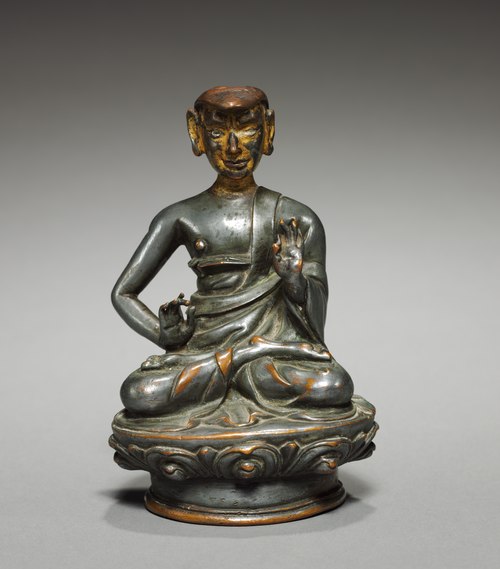
Sources and credit for Dharmakīrti
Creator not identified in the source record. Via Wikimedia Commons. Image source · CC0 · Biographical dates
His analysis emphasizes grounds such as causal dependence and identity or essential connection for warranted inference, rather than treating repeated observation alone as sufficient for every generalization.
Smoke can indicate fire because of the relevant causal relationship. Other inferential patterns concern an object's falling under a broader description or the significance of nonperception under suitable conditions.
The qualification on nonperception matters. Failing to see an object does not establish its absence when lighting, distance, or other conditions prevent perception.
Nyāya and Buddhist authors disagreed about universals, particulars, language, and the justification of inference. Their shared use of inferential examples should not hide these foundational differences.
Language and exclusion
Buddhist discussions associated with apoha analyze conceptual and linguistic classification through exclusion.
Understanding a general expression raises a problem when the theory gives priority to particulars rather than independently existing universals. What does the word apply to, and how is its conceptual range determined?
Accounts of exclusion address this problem within a broader theory of cognition. They should not be casually equated with Boolean complementation: the philosophical issue concerns how concepts and words function, not merely an operation on already specified sets.
This branch connects logic with semantics and epistemology in a way that a purely propositional reconstruction would miss.
Gaṅgeśa and Navya-Nyāya
Gaṅgeśa's Tattvacintāmaṇi, commonly situated around the fourteenth century, became a central work in Navya-Nyāya, the “new” Nyāya tradition.
Its analysis of knowledge and inference helped develop an exceptionally precise technical language for properties, relations, qualifications, and absences.
Raghunātha Śiromaṇi, active around the late fifteenth and early sixteenth centuries, critically reworked inherited positions. Later scholars continued the analytical tradition in major intellectual centers.
The specialist account of Gaṅgeśa explains the work's structure and its relationship to subsequent developments.
Why relational precision matters
Consider the assertion “The pot is absent.”
Absent where, and at what time? A pot absent from the floor might be present on a shelf. The claim requires a locus, a relevant object or counterpart, and the relation under which its absence is being asserted.
Navya-Nyāya's terminology can specify such dependencies with considerable precision. Its dense expressions aim to prevent an argument from changing the relevant property or relation unnoticed.
This example illustrates an analytical purpose without pretending that the tradition's language is simply modern predicate notation written in Sanskrit.
A distinct historical achievement
Indian logical traditions developed rigorous analyses of signs, counterexamples, relations, and the means of knowledge. Their history contains sustained disagreement and innovation.
Claims of influence between these traditions and other logical cultures require documentary evidence. Similar problems can arise independently, and similar-looking arguments can serve different epistemological aims.
The next companion examines Chinese traditions of names, distinctions, and argument without assuming that they occupy the next stage of one universal chronology.
Sources and further reading
- Nyāya-sūtra, especially the discussion of the members of an argument, with Vātsyāyana's commentary.
- Dignāga, Pramāṇasamuccaya; Dharmakīrti, Pramāṇavārttika and Nyāyabindu.
- Gaṅgeśa, Tattvacintāmaṇi, particularly the section on inference.
- Raghunātha Śiromaṇi, Dīdhiti and related analytical works.
- Logic in Classical Indian Philosophy and Gaṅgeśa, Stanford Encyclopedia of Philosophy.
- Bimal Krishna Matilal, The Character of Logic in India (1998).